Originally published . AI polished for a better reading experience: .
In his article “Does Third World Growth Hurt First World Prosperity?” Paul Krugman analyses fears that were spreading in US society as growth in developing countries accelerated. Using the theory of comparative advantage, he explains how an increase in production in one part of the world need not harm another. I can subscribe to everything in that article, yet I think there are more perspectives than those he highlights. In particular, we should not look at “prosperity” only in nominal terms, as Krugman largely does, but also in relative terms. How do we know one country is rich and another poor? By the difference between them. If that difference shrinks, the rich country becomes relatively less rich than it was before.
Should we care about relative prosperity? There are at least two reasons we do. The first is psychological. How do I measure my salary? By benchmarking other options in the market. If my pay is high compared with others, I feel better. If it is average, I am fine but may start looking elsewhere. If it is below the industry average, I will underperform and leave as soon as I can. Does the same apply to countries? To some extent, yes. We call Switzerland rich because it is rich among its neighbours. We do not casually call the Czech Republic rich, even though it outranks more than a hundred and fifty countries on GDP per capita (PPP), because we place it relative to other EU peers. As eastern European countries gather momentum, they may eventually overtake southern European ones in the prosperity rankings. Does that matter to citizens of the countries that slip? I think so: there is a human urge to be better than others. Even when nominal prosperity is unchanged, relative convergence or rank changes can feel like a loss.
The other reason appears in Krugman’s paper itself, framed as a threat to first-world wages:
Suppose, then, that Third World nations become more attractive than First World nations for First World investors. This might be because a change in political conditions makes such investments seem safer or because technology transfer raises the potential productivity of Third World workers (once they are equipped with adequate capital). Does this hurt First World workers? Of course. Capital exported to the Third World is capital not invested at home, so such North-South investment means that Northern productivity and wages will fall. Northern investors presumably earn a higher return on these investments than they could have earned at home, but that may offer little comfort to workers.
Krugman also argued that the volumes involved were so small they hardly mattered (“The record capital flows of 1993 diverted only about 3% of First World investment away from domestic use”). The article was written in 1994; it is striking that he did not foresee how large emerging economies would become over the next fifteen years. Look at the graph below — it largely speaks for itself:
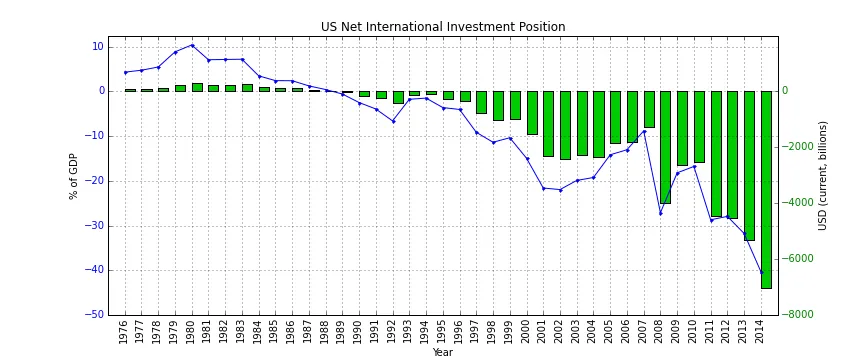
Interesting, right? Link that path to “capital exported to the Third World is capital not invested at home…” and you have one confirmation that the threat can be real.
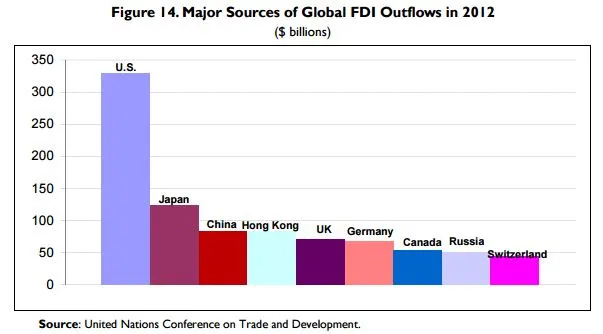
To stay fair, Chinese investment into the United States exists as well. The next graph gives a sense of who invests how much. Major investors remain first-world countries, so the conclusion above still applies — though in the long run the story is muddied by imperfections in the global monetary system, which I return to below when discussing Bitcoin.
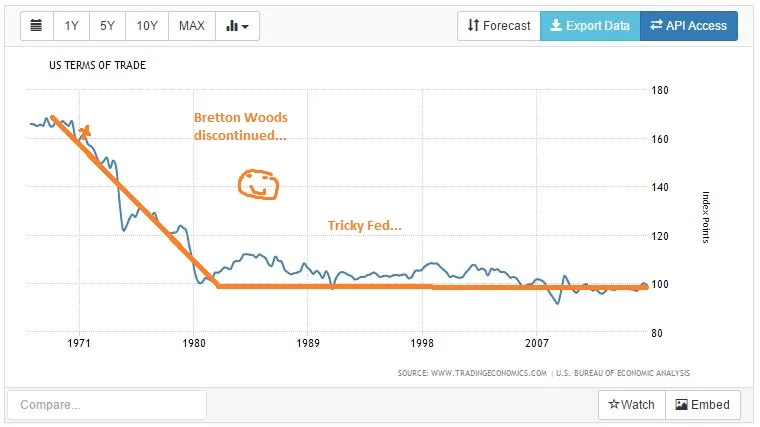
Krugman also notes that terms of trade can be a source of worry when they fall below 100 — we sell products more cheaply than others, so buyers may pay more for imports. I will not digress into how one-sided that worry can be (customers may be unhappy while exporters are happy). What I will say is that, after Bretton Woods unravelled, I think the Fed has tended to manage the dollar so that US terms of trade stay as close to 100 as possible.
Introducing scarcity: the world after Bitcoin
Now imagine a possible future among many — one in which Bitcoin has become a global currency. No monetary policy, no reserve-requirement coefficients; money is genuinely scarce, and you can lend only what you have, no more and no less. What happens if, in a world of one scarce resource, one country becomes more efficient? Two things: the global value of labour appreciates (you produce more with the same labour), so products become cheaper; but because your relative weight against the other country has fallen, competition for the scarce resource intensifies. You must work harder to obtain it. Humanity wins, yet your prosperity may still be undermined because you face fiercer rivalry for the global scarce asset.
Everything above should be taken with a grain of salt. Even if the evidence suggests that rising productivity in the developing world can have negative side effects in the developed world, we should still understand that in the long run humanity wins. This essay is not a protectionist brief; it is a mental model of different ways to read the global economy when the status quo is challenged. If we look in nominal terms — and especially if we look globally, over the long term — trade built on comparative advantage still produces a win-win for everyone willing to face healthy competition.
Comments
Loading…
Log in or register to comment.